
Intro
If your knee aches around or behind the kneecap every time you run, climb stairs, or sit too long with bent knees, you may have runner's knee. It is one of the most common reasons runners, soccer players, hikers, and gym-goers in Surrey walk into a physiotherapy clinic. The good news is that most cases improve well with the right rehabilitation, and surgery is rarely needed.
This guide explains what runner's knee really is, why it develops, what the research says actually works, and how runner's knee treatment in Surrey at Renew Physiotherapy and Sports Clinic is built around your knee, your training, and your goals. You will also find a staged exercise plan, a realistic return-to-running approach, and clear answers to the questions people ask us most.
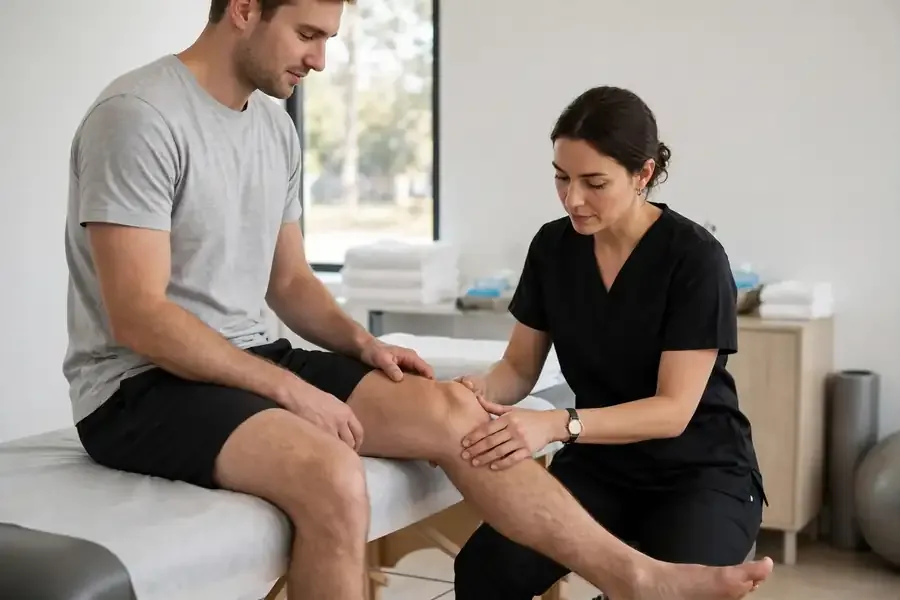
What Is Runner's Knee?
Runner's knee is the common name for patellofemoral pain syndrome. It is pain that comes from the joint between the kneecap (patella) and the thigh bone (femur), where the kneecap glides in a groove every time the knee bends and straightens.
Despite the name, you do not have to be a runner to get it. We see it in soccer players from Newton Athletic Park, hikers training for the summer, people starting a new gym routine in Cloverdale or Fleetwood, and anyone whose knee is suddenly asked to do more than it is ready for. It often builds up gradually rather than after one specific injury, which is why many people cannot point to the moment it started.
The pain is usually felt around or behind the kneecap. It tends to be worse with running, walking downhill, squatting, lunging, jumping, and going up or down stairs. Many people also notice it after sitting for a long time with the knees bent, for example in a car, at a desk, or in a cinema seat. Physiotherapists sometimes call that the "movie theatre sign."
What Causes Runner's Knee?
For years, runner's knee was blamed on the kneecap "tracking wrong" or being "out of place." Current research tells a simpler and more useful story: the pain usually appears when the knee is asked to handle more load than it currently has the capacity for.
That overload can come from many directions:
The important point is that pain does not always mean something is damaged. In most cases it means the knee needs greater capacity for the demands being placed on it. That is exactly what rehabilitation builds. Finding the cause is the first step of runner's knee treatment in Surrey, because two people with the same pain often need different plans.
Signs Your Knee Pain Could Be Runner's Knee
Runner's knee does not always announce itself clearly. Some people feel a dull ache that builds over a run. Others notice it only on stairs or after sitting. Watch for these signs:
- Aching pain around or behind the kneecap, often in both knees over time
- Pain when running, especially downhill or after increasing distance
- Pain going up or down stairs, or when squatting and lunging
- Stiffness or aching after sitting with bent knees for a while
- Clicking or grinding around the kneecap, usually without locking
- Tenderness when you press around the edges of the kneecap
- Knee pain that eases with rest but returns as soon as training resumes
Pain that is worst with stairs, squats, and sitting, rather than with one sharp twist, is the classic runner's knee pattern. If your knee locks, gives way, swells up quickly after an injury, or you cannot put weight on it, that points to something else and needs a prompt assessment.
Runner's Knee or Something Else?
Several knee conditions cause pain at the front of the knee, and they need different treatment. A proper assessment matters, because the exercises that help one condition can aggravate another.
Patellar tendonitis (jumper's knee)
IT band syndrome
Meniscus or ligament injury
Shin splints
Knee arthritis
Arthritis pain tends to be a dull ache with morning stiffness that eases as you move, and it often affects people later in life. Runner's knee is more common in active younger adults and teenagers, and the pain is more closely tied to loading the knee. The two can exist together, and physiotherapy helps both.
Your physiotherapist uses your history, hands-on testing, strength checks, and movement assessment to work out which structure is causing the problem. No single test proves runner's knee on its own. The picture comes from putting all the findings together.
What the Research Says Actually Works
The strongest evidence for runner's knee supports exercise therapy, particularly a combination of hip and knee strengthening. This approach has been shown to reduce pain and improve function in both the short and long term. That is the foundation of runner's knee treatment in Surrey at Renew, and it is worth knowing what the evidence does and does not support.
What Happens at Your First Visit to Renew
Your first visit is about understanding your knee and your training, not just the pain.
We start by talking through when the pain began, what makes it worse, and what you need your knee to do. Your running history matters: weekly mileage, recent changes, hills, speed work, shoes, surfaces, and how you recover between sessions. We also ask about work, sport, and daily activities, because they all shape the plan.
Then we assess. A typical runner's knee assessment at Renew may include strength testing of the hips and quadriceps, hip and ankle mobility, single-leg balance and control, squat and lunge mechanics, and a running or sport-specific movement check when appropriate. We also look at how the knee behaves on stairs and during a step-down, since that is where most people feel it first.
By the end of the visit, you will know what we think is causing your pain, what the plan looks like, how your runner's knee treatment in Surrey will be structured, and what you can do this week. Two people can have the same diagnosis and need completely different plans depending on why their symptoms developed, so the plan is built around your findings, not a template.
You do not need a doctor's referral to book physiotherapy in British Columbia. Most extended health plans cover physiotherapy, and we provide receipts for your claim.
7 Steps of Runner's Knee Treatment at Renew
This is the recovery path we follow for runner's knee treatment in Surrey at Renew. Every plan is personal, but the steps are the same.
Step 1: Calm the knee down
In the first days, the goal is to settle the pain. We reduce the most aggravating activities for a short time, use ice after activity if it helps, and keep you moving gently. Complete rest is rarely needed. Short, comfortable walks and easy cycling usually keep the knee from stiffening up.
Step 2: Restore full movement
We work on getting the knee bending and straightening fully again, along with the hips and ankles, which all affect how the knee moves. Hands-on treatment and guided mobility work help, and we never force a stiff joint.
Step 3: Wake up the hips and quadriceps
After knee pain, the thigh and hip muscles often switch off or weaken. Simple activation exercises, like glute bridges and quadriceps sets, switch them back on. This step is short but important, because everything that follows depends on these muscles working.
Step 4: Build strength step by step
Once the knee moves well and the muscles are working, we add progressive strengthening. Step-ups, split squats, hip thrusts, and lateral step-downs build the muscles that protect the kneecap. Load increases slowly, guided by how your knee responds the next day.
Step 5: Retrain balance and control
Single-leg balance, controlled squats, and slow direction changes teach the knee to stay steady. This step matters most for runners returning to trails, soccer players cutting on the field, and anyone working on uneven ground.
Step 6: Return to running
We rebuild your running gradually, usually with a walk-run plan, then easy mileage, then hills and speed. We test the knee under running demands before clearing you for full training, and we adjust the plan if pain flares.
Step 7: Keep the knee strong for good
Recovery does not end when the pain stops. A short strength program, done two or three times a week, keeps the knee strong and lowers the chance of the pain coming back. We review it with you and adjust it as your training changes.
Exercises That Help Runner's Knee
Exercise is the core of runner's knee treatment in Surrey. The right exercises depend on your stage of recovery, so never copy a program from the internet without an assessment. Here is how a program usually progresses at Renew.
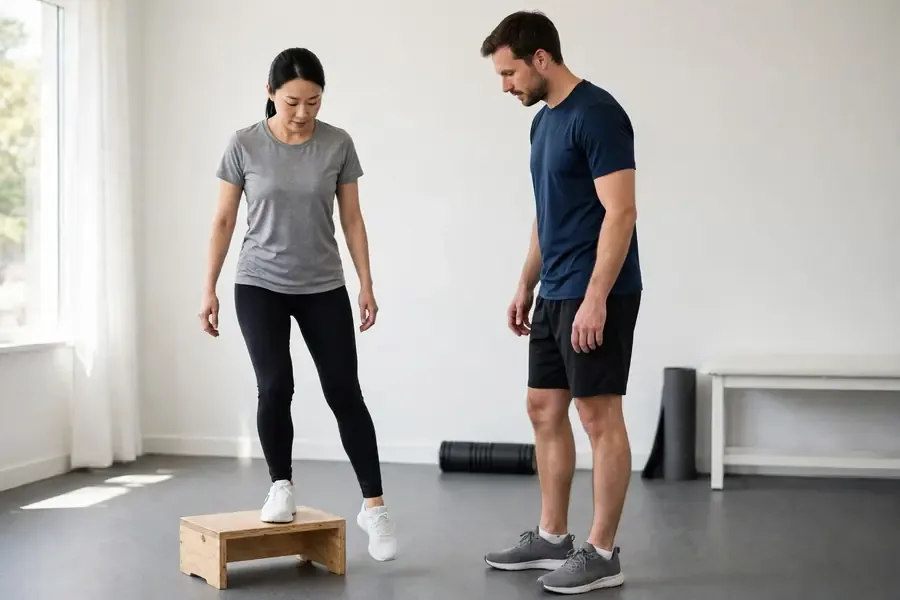
Early stage: calm and activate
- Quadriceps sets: tighten the thigh muscle with the leg straight, hold for 5 seconds, relax. Repeat 10 times, 3 times a day.
- Glute bridges: lift your hips while squeezing your glutes, hold, and lower slowly.
- Straight-leg raises: lift the straight leg a few inches off the bed or floor, hold, and lower slowly.
- Clamshells: lie on your side with knees bent and open the top knee like a clamshell, keeping the feet together.
Middle stage: build strength
- Step-ups: step onto a low step with the sore leg, then step down slowly and with control.
- Split squats: a stationary lunge that loads the front leg, keeping the knee tracking over the toes.
- Hip thrusts: drive the hips up from the shoulders, squeezing the glutes at the top.
- Lateral step-downs: stand on a low step and slowly lower the other foot toward the floor, then return.
- Single-leg calf raises: rise onto the toes of one foot and lower slowly, holding a counter for balance.
Later stage: control and return to running
- Bulgarian split squats: rear foot raised on a chair or bench, lower slowly and drive up through the front leg.
- Single-leg balance: stand on the sore leg for 30 seconds, then switch, progressing to eyes closed or on a cushion.
- Slow direction changes: practise turning and stepping in different directions at walking pace, then jogging pace.
- Walk-run intervals: short running intervals with walking breaks, building the running time week by week.
As a guide, mild discomfort during exercise, up to about 3 out of 10, is acceptable if it settles shortly afterwards and is no worse the next day. Sharp pain, swelling that lasts more than a day, or pain that keeps rising means the exercise or the load needs adjusting. Tell your physiotherapist and do not push through it.
Can I Keep Running?
Often, yes. Many people with runner's knee do not need to stop running completely. Instead, we change the training that is overloading the knee.
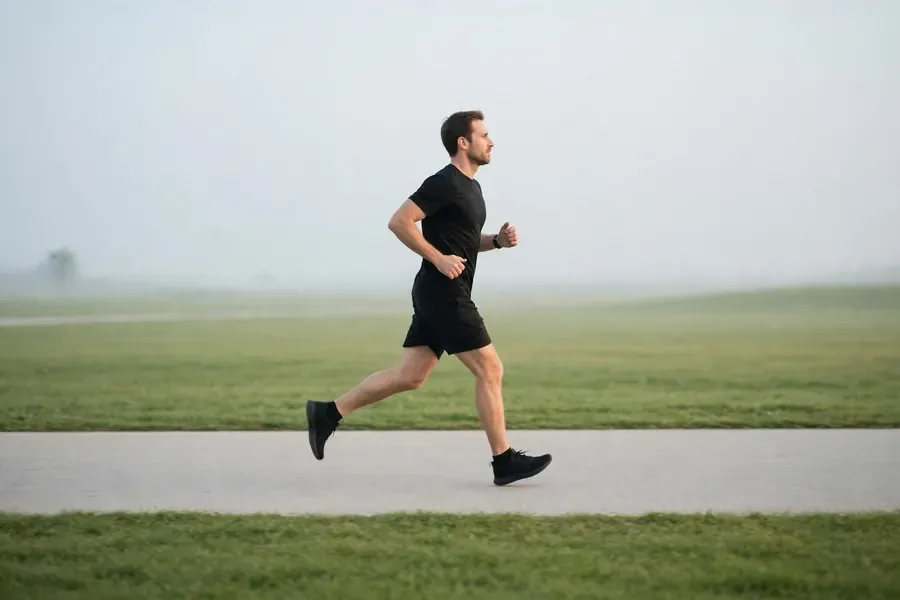
That usually means adjusting weekly mileage, cutting back on speed work and hills for a while, and reducing running frequency until the knee settles. A walk-run plan is often the best bridge: for example, alternating one minute of easy running with one minute of walking, then gradually increasing the running intervals as the knee tolerates them. Keeping some running in your program, when appropriate, helps maintain fitness and makes the return to full training smoother. A graded walk-run plan like this is a standard part of runner's knee treatment in Surrey for runners who want to keep training.
Surrey's trails can be part of the problem and part of the solution. Soft trails at Green Timbers or Bear Creek Park are gentler than pavement, but wet, muddy, or hilly sections load the knee more. Flat, even surfaces are the best place to rebuild mileage, and hills come back later, in small doses.
A conservative guide many runners use is to increase weekly running time or distance by no more than about 10 percent per week. It is a guide, not a rule, and your physiotherapist will adjust it to how your knee responds.
How Long Does Recovery Take?
Recovery time depends on how long the pain has been there, how weak the hips and quadriceps are, and how consistent you are with the plan. As a rough guide, most people notice real improvement within 6 to 12 weeks of consistent rehabilitation. Some feel better in 4 to 6 weeks, especially if the problem is recent. Pain that has been present for months often takes longer, sometimes 3 to 6 months, because the knee needs more time to rebuild capacity.
What matters most is consistency. That consistency is what makes runner's knee treatment in Surrey work: the home exercises matter more than the visits themselves. The people who recover fastest are usually the ones who do their home exercises between visits and follow the loading plan, not the ones who train hardest. Runner's knee is one of the conditions that responds very well to the right rehabilitation, but it rewards patience.
7 Everyday Tips to Protect Your Knees
Small habits protect the kneecap while it heals and after recovery. These habits support your runner's knee treatment in Surrey and protect the knee afterwards:
- Build mileage slowly. Add distance, hills, or speed one at a time, never all at once.
- Keep the hips and thighs strong. A few minutes of strengthening, two or three times a week, is the best long-term protection you have.
- Warm up before running. Five to ten minutes of easy movement, leg swings, and gentle squats prepare the knee for harder work.
- Choose your surface. Rebuild mileage on flat, even ground first. Add trails and hills in small doses once the knee is coping.
- Replace worn shoes. Running shoes lose their cushioning long before they look worn out. If your shoes have covered a lot of kilometres, they may be adding load to your knees.
- Do not sit still for too long. If sitting with bent knees hurts, stand and move every 30 to 45 minutes. A short walk or a few straight-leg raises can ease the ache.
- Listen to the next day. If the knee is more painful or swollen the morning after a run, that run was too much. Scale it back and build up more slowly.
When to Book an Appointment
Book an assessment if your knee pain has lasted more than a few days, if it keeps coming back when you run, if stairs or sitting provoke it, or if you cannot bend or straighten the knee fully. The earlier you start, the faster the recovery usually is.
Seek urgent medical care if the knee is locked and will not move, if it is severely swollen or visibly deformed, if you cannot put weight on it, if the pain is severe at rest or at night, or if you have numbness, major weakness, or fever with redness around the joint.
Frequently Asked Questions
What is runner's knee?
Runner's knee, or patellofemoral pain syndrome, is pain around or behind the kneecap caused by the joint between the kneecap and the thigh bone being loaded more than it can currently tolerate. It is common in runners, soccer players, hikers, and gym-goers, and it usually builds up gradually rather than after one injury.
How long does runner's knee take to heal?
Most people notice real improvement within 6 to 12 weeks of consistent physiotherapy and home exercises. Some recover in 4 to 6 weeks if the problem is recent. Pain that has been present for months can take 3 to 6 months. Recovery from runner's knee treatment in Surrey is faster when you follow the loading plan and do your exercises between visits.
Should I stop running completely with runner's knee?
Usually not. Most people can keep some running in their program by reducing mileage, hills, and speed for a while, and by using a walk-run plan. Complete rest rarely helps long-term, because the knee needs gradual loading to rebuild strength. Your physiotherapist will help you find the amount your knee can tolerate.
Does runner's knee need surgery?
Surgery is rarely needed for runner's knee. Physiotherapy, activity changes, and strengthening are the first choice for almost everyone. Surgery may be considered only if symptoms persist despite extensive non-surgical treatment and imaging shows a structural problem that can be corrected.
Is walking good for runner's knee?
Yes, in most cases. Short, comfortable walks are usually helpful and keep the knee from stiffening up. Avoid long walks, steep downhill sections, or uneven ground until the knee settles.
What is the difference between runner's knee and patellar tendonitis?
Runner's knee causes pain around or behind the kneecap and is worst with stairs, squats, and sitting. Patellar tendonitis causes pain just below the kneecap, in the tendon, and is worst with jumping and landing. The two can occur together, so an assessment is needed to tell them apart.
Disclaimer
This article is for general information only and is not medical advice. Every knee is different, and the right treatment depends on your own assessment. If you are unsure about your knee, book an appointment with a physiotherapist or speak with your doctor before starting any exercise program.
Book Your Assessment
Runner's knee treatment in Surrey is available at Renew Physiotherapy and Sports Clinic in Cloverdale. Book an assessment today and take the first step toward running without knee pain. Call (236) 450-0171 or book online, and we will get you moving again.
Renew Physiotherapy and Sports Clinic, 5722 176a Street, Surrey, BC V3S 4H2. Phone (236) 450-0171. Email Info@renewclinics.ca.