
Did you feel a sharp pull in your inner thigh as you kicked a ball, cut sideways, or sprinted for a bus, and now every step, stair, and squeeze of your legs together hurts? You most likely have a groin strain, and the good news is that groin strain treatment Surrey physiotherapists provide follows a clear, evidence-based path that gets most people back to full activity without surgery.
A groin strain (also called an adductor strain or a pulled groin) is a stretch or tear of the inner thigh muscles that pull your leg toward the midline of your body. It is one of the most common lower-body injuries in soccer, hockey, basketball, and running, but it also happens in everyday life: slipping on wet grass, lifting something heavy with a twist, or stepping awkwardly off a curb. Rest alone is rarely enough to fix it. Muscles that heal without being reloaded stay weak, and weak adductors are the single biggest reason groin strains come back.
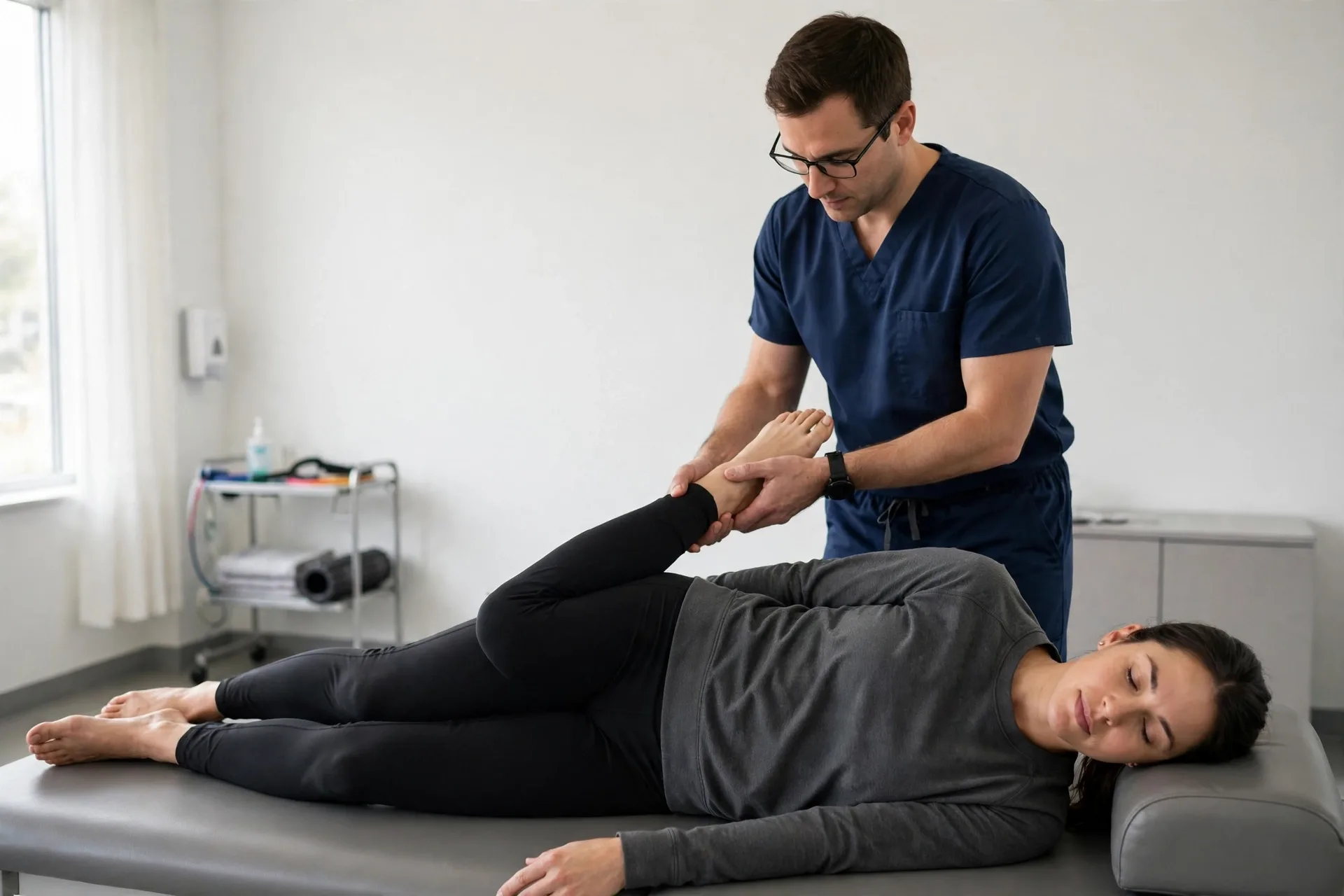
What Is a Groin Strain?
The groin is the crease where your thigh meets your pelvis, and the muscles that live there are the adductors. There are five of them: the adductor longus, adductor brevis, adductor magnus, gracilis, and pectineus. They run from the pubic bone at the front of your pelvis down the inner thigh, and their job is to pull the leg inward toward the other leg (adduction), stabilize the pelvis when you stand on one leg, and help control the leg as it swings through when you run and kick.
The adductor longus is by far the muscle strained most often. It sits high in the groin, attaches to the pubic bone, and works at a mechanical disadvantage during explosive movements: when you kick, cut, or push off sideways, it has to contract hard while it is being lengthened, and that combination (a strong contraction while the muscle is stretching, called an eccentric contraction) is exactly how muscle fibres tear. Groin and adductor strains account for roughly 10 to 18 percent of all injuries in field sports such as soccer and ice hockey, which is why Surrey soccer and hockey players are the patients we see most with this injury.
A strain is not a sprain. A sprain injures a ligament (the tissue connecting bone to bone, as in an ankle sprain). A strain injures a muscle or its tendon. That difference matters because muscles heal by rebuilding strength through progressive loading, while ligaments heal by regaining stability and control. A groin strain hurts in the muscle belly or where the tendon attaches to the pubic bone, and it hurts when you squeeze your legs together against resistance. Pain that behaves differently, for example deep hip pain that clicks, or a bulge in the groin crease that appears when you cough, points to a different problem entirely, which is why a proper assessment comes before any exercise program.
Causes and Risk Factors
Most groin strains happen in a single moment: a forceful kick, a sudden change of direction, a slip where the legs split apart, or a sprint start. The classic sports are soccer, ice hockey, basketball, rugby, and martial arts, but we also see groin strains from gym injuries, slipping on ice, and physically demanding jobs.
Several factors raise your risk, and most are fixable:
- Weak adductors relative to the outer hip muscles (abductors). When the inner thigh is much weaker than the glutes, the adductors get overloaded every time you cut or land. This imbalance is the most consistent risk factor in the research.
- A previous groin strain. A prior injury that was rested but never fully strengthened is the strongest predictor of another one. Groin strains have one of the highest recurrence rates of any muscle injury when rehab is cut short.
- Sudden jumps in training load. Returning to full-intensity soccer after a quiet winter asks the adductors for capacity they have not built yet.
- Limited hip movement or previous hip problems. A stiff hip forces the adductors and pubic bone to absorb rotation they are not designed for. This is one reason groin pain and hip pain so often overlap, and why both are checked at your first visit.
- Skipping warm-ups and strength work. Cold, unprepared muscle tears more easily, and athletes who do no adductor strengthening carry higher risk than those who train the inner thigh deliberately.
Grades of Groin Strain: How Severe Is Yours?
Groin strains are graded from 1 to 3 by how much of the muscle is damaged. The grade guides your timeline, although your physiotherapist will also weigh where the tear is and how your strength tests, because two injuries with the same grade can behave differently.
- Grade 1 (mild). A few fibres are stretched or micro-torn, with swelling but no visible tear. Pain is mild, strength is mostly preserved, and walking is normal, though sprinting and kicking hurt. Typical recovery: about 1 to 3 weeks (median about 21 days to full training in the main rehab study).
- Grade 2 (moderate). A partial tear, with a fluid-filled gap in the muscle on imaging. Pain is sharper, strength is reduced, walking may limp, and bruising often appears a day or two later. Typical recovery: about 3 to 8 weeks (median about 21 days in the same study, range 7 to 57 days; a 30-study review put partial tears at 1 to 7 weeks).
- Grade 3 (severe). A complete tear, or the tendon pulled off the bone (avulsion), usually with sudden severe pain, sometimes a pop, marked bruising, and difficulty walking. Typical recovery: about 8 to 16 weeks. A grade 3 injury needs a doctor within 1 to 2 days for imaging and a surgical opinion, since a tendon torn off the bone in a young athlete is sometimes repaired.
Symptoms of a Groin Strain
A groin strain usually announces itself clearly:
- Sudden sharp pain in the inner thigh or high groin during a kick, cut, sprint, or slip, sometimes with a pop or tearing feeling.
- Pain when you squeeze your knees together, bring the leg across your body, or get in and out of a car.
- Tenderness when you press along the inner thigh muscles, often high near the pubic bone.
- Pain with speeding up, kicking, side-stepping, climbing stairs, or standing on the injured leg to put on pants.
- Bruising in the inner thigh that appears a day or two after larger tears, sometimes tracking down toward the knee.
- Stiffness after rest that eases with gentle movement, and a protective tightening (spasm) of the inner thigh.
- Difficulty walking normally in the first days, with a shortened stride on the injured side.
What to Do in the First 48 Hours
What you do in the first two days sets up everything that follows. Modern soft-tissue care follows the POLICE principle (Protect, Optimal Loading, Ice, Compression, Elevation), which has replaced total rest because early gentle loading helps muscle fibres heal in an organized way rather than as weak scar.
- Stop the activity. Do not try to play through it or stretch it out aggressively. Continuing to kick or cut on a freshly torn adductor turns a small tear into a bigger one.
- Protect it for 2 to 3 days. Relative rest means avoiding kicking, side-stepping, and wide stances, not bed rest. Walk within comfort; use crutches briefly if you are limping badly.
- Ice it. Apply ice for 15 to 20 minutes every 2 to 3 hours for the first 48 to 72 hours, wrapped in a thin towel, never directly on skin. Ice is for pain relief; it does not speed healing by itself.
- Compress if it helps. Compression shorts or a snug elastic wrap around the upper thigh can ease symptoms and give a feeling of support. They are optional, not mandatory.
- Avoid heat, alcohol, and deep massage for the first two days, and avoid aggressive stretching. All of these can increase bleeding inside the muscle and enlarge the injury.
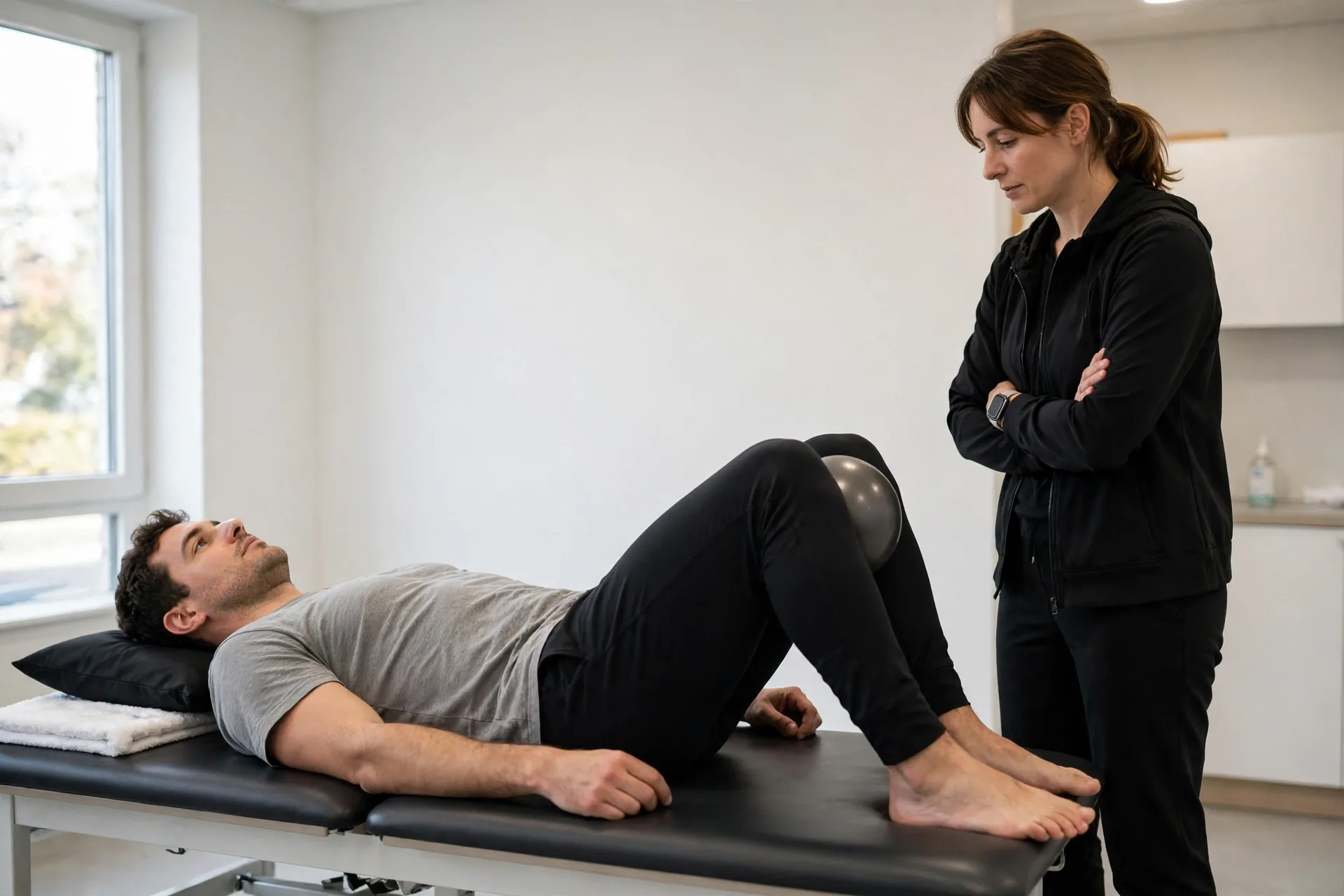
- Start gentle squeeze holds from about day 3. Lying on your back with knees bent, squeeze a ball between your knees at well below full effort, holding about 20 seconds, 5 times, twice a day, pain at 3 out of 10 or less.
- Book an assessment. A physiotherapist can grade the injury, rule out hernia and hip problems, and set your starting dose. No doctor's referral is needed in BC.
How a Groin Strain Is Diagnosed
Diagnosis starts with your story and a hands-on examination. You will be asked how it happened, where the pain sits, whether you felt a pop or saw bruising, and whether you have had groin trouble before. Wear shorts or loose pants so the hip and inner thigh can be examined comfortably.
Groin Strain Treatment in Surrey: How Physiotherapy Helps
Exercise-based rehabilitation is the main treatment, and the evidence is clear: active strengthening returns athletes faster, with fewer recurrences, than rest-based care (about 6 to 8 weeks versus 10 to 14 weeks for grade 1 to 2 strains in a 2021 review). At Renew Physiotherapy in Surrey, treatment moves through three phases, and you advance when you meet the criteria, not when a calendar says so.
Exercises for a Groin Strain
These exercises are general guidance, not a prescription. Keep pain at 3 out of 10 or less, with no next-day flare; if symptoms flare for more than a day, scale back one step.
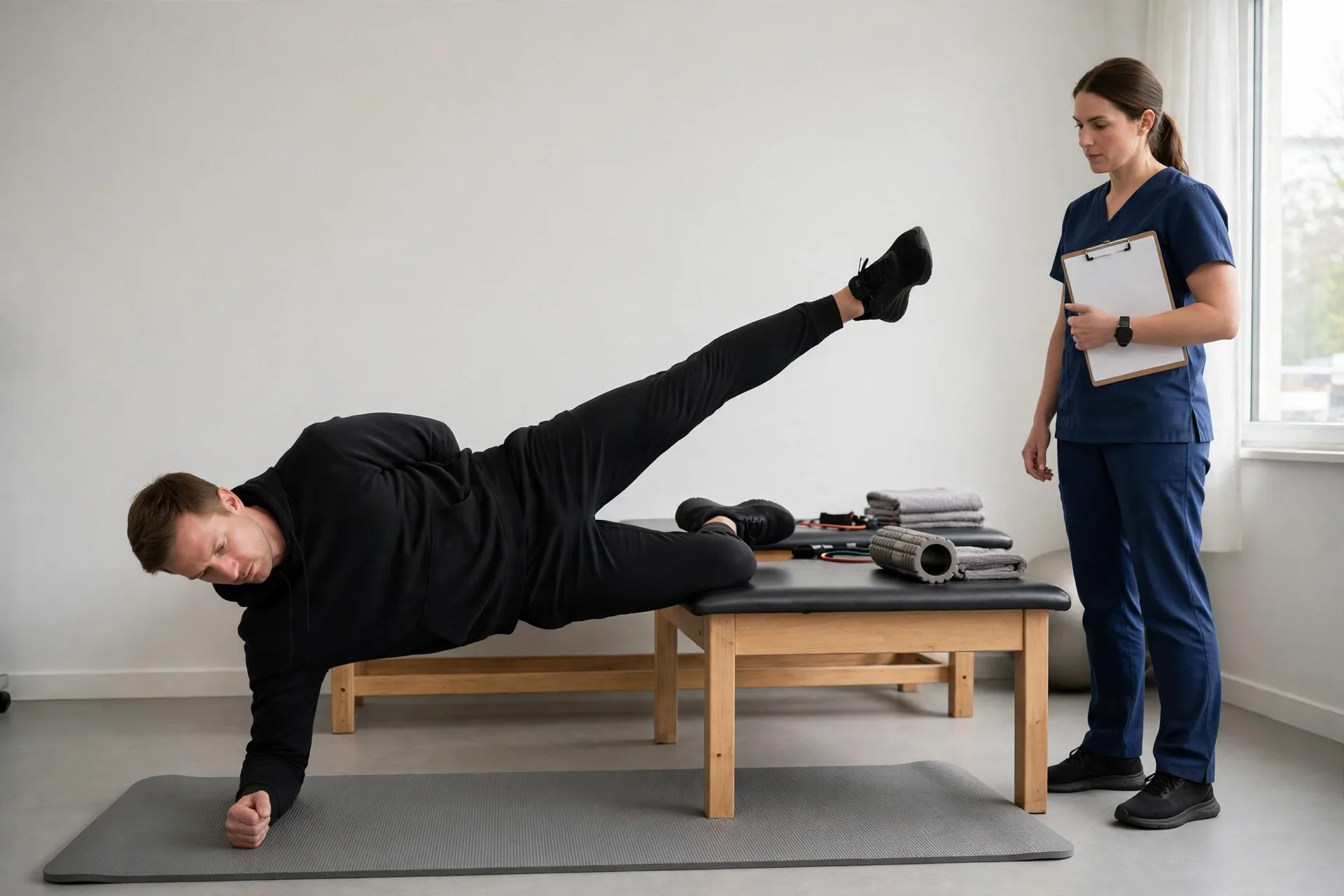
- Level 1 (knee support). Lie on your side with your top leg resting on a bench or sturdy chair, supported at the knee. Lift your bottom leg up to meet the bench while raising your hips off the floor, hold 2 seconds, then lower under control. Do 2 sets of 10 each side.
- Level 2 (ankle support). The same movement, but the top leg is supported at the ankle instead of the knee. The longer lever increases the load. Do 2 sets of 8 each side.
- Level 3 (partner or full dynamic). A partner supports your top ankle at about hip height while you raise and lower your body and bottom leg slowly, controlling the descent. Do 3 sets of 8 to 10. This level is for later-stage athletes and is best learned in the clinic first.
Recovery Timelines and Return to Sport
Recovery is measured in weeks, and the honest answer depends on the grade, the location, and whether you have injured the groin before:
- Grade 1 (mild): about 1 to 3 weeks to full activity, with supervised criteria-based rehab typically returning athletes to full training around 3 weeks.
- Grade 2 (partial tear): about 3 to 8 weeks. The range is wide because a small partial tear in the muscle belly and a larger tear near the tendon are very different injuries with the same label.
- Grade 3 (complete tear or avulsion): about 8 to 16 weeks, usually within 3 months with rehabilitation; a surgical opinion is part of the early plan.
- Long-standing adductor-related groin pain: often several months of progressive strengthening. These cases involve strength loss that takes time to rebuild, and they improve steadily rather than suddenly.
- Desk work: usually manageable within days, with care getting in and out of chairs and cars.
- Physical work involving lifting, climbing, or stepping over obstacles: may need 2 to 6 weeks of modified duties, depending on the grade.
Red Flags: When to Get Checked Promptly
Most groin strains can be assessed within a few days, but some signs mean you should not wait:
- Sudden severe pain with an audible pop, and you could not carry on. This can be a complete tear or the tendon pulled off the bone; see a doctor within 1 to 2 days for imaging and a surgical opinion.
- Extensive bruising spreading down the inner thigh within 24 hours, which suggests a high-grade tear.
- You cannot put weight on the leg, or groin pain in a runner that builds with every run and hurts when hopping. This can be a stress fracture of the hip; stop running, keep weight off the leg, and get same-day medical assessment.
- A lump in the groin crease, or pain with coughing, sneezing, or bearing down. This may be a hernia rather than a muscle strain; see your family doctor. A groin lump with sudden severe pain, vomiting, or difficulty passing stool or wind is an emergency.
- Sudden severe testicular pain. Go to emergency now; do not treat this as a groin strain.
- Fever, chills, or feeling generally unwell with groin pain or a hot, swollen hip, which can signal a joint infection and needs emergency care.
- A child or teenager with a new unexplained limp and hip, groin, thigh, or knee pain. Hip problems in teenagers can present as groin or knee pain; get prompt medical assessment before starting exercises.
- No improvement after 2 weeks of appropriate rehabilitation, which warrants imaging and a sports medicine review.
Preventing Another Groin Strain
Groin strains are famous for coming back, but recurrence is largely preventable. The Copenhagen program is the best-supported prevention tool we have: teams using it three times a week in preseason and once a week in season reported 41 percent fewer groin problems. Two short sessions a week of the level you can do well, kept up after rehab ends, is a reasonable maintenance dose for most recreational athletes. Balance it with outer-hip and core strengthening, build training load gradually after holidays and off-seasons, and warm up with progressive running before kicking at full power. Finally, finish your rehab: stopping at "pain-free" instead of "strong" is the single most common reason we see the same patient again next season.
Frequently Asked Questions
It depends on the grade: about 1 to 3 weeks for a mild (grade 1) strain, 3 to 8 weeks for a partial tear (grade 2), and 8 to 16 weeks for a complete tear (grade 3). Under supervised criteria-based rehab, athletes with small to moderate injuries returned at a median of about 21 days, complete tears at about 78 days. That is why groin strain treatment Surrey physiotherapists provide is criteria-based: you progress when strength tests say you are ready.
Both, in the right order. Rest from kicking, cutting, and sprinting for 2 to 3 days, then start gentle loading such as ball-squeeze holds from about day 3. Complete rest beyond the first few days weakens the muscle and slows recovery; early optimal loading beats immobilization. Keep pain at 3 out of 10 or less, with no next-day flare.
It is a side-lying exercise where your top leg rests on a bench or a partner's hands while you lift your body and bottom leg with the inner thigh muscles, then lower slowly. In a trial of 35 professional soccer teams, a Copenhagen-based program reduced groin problems by 41 percent. It is introduced in levels (knee, then ankle, then partner support) once early-phase criteria are met.
A strain hurts when you squeeze your legs together, kick, or cut, and usually follows a clear moment of injury. A hernia more often causes a groin-crease lump and pain with coughing or straining. The groin crease is checked at your assessment; if a hernia is suspected, you will be referred to your family doctor.
See a physiotherapist if squeezing your legs together hurts, if bruising appeared, if you cannot jog without pain after a week, or if groin pain keeps returning. See a doctor within 1 to 2 days if you felt a pop and could not continue, and seek emergency care for the red flags above. No doctor's referral is needed in BC.