
Is the bony bump at the base of your big toe getting sorer every month, making closed shoes harder to wear and long walks or shifts on your feet harder to finish? That bump is usually a bunion, and bunion treatment Surrey physiotherapists provide starts with an honest point that shapes everything else in this guide: physiotherapy cannot straighten the bone back to where it started, but it can reduce pain, keep the big toe joint moving, strengthen the foot, and help you walk, work, and stay active more comfortably.
A bunion, called hallux valgus in medical language, is a gradual shift in the bones of the forefoot. The long bone behind the big toe (the first metatarsal) drifts outward, toward the other foot, while the big toe itself leans inward toward the second toe. The joint where they meet bulges out on the inner side of the foot, and that bulge is the bump you can see and feel. Bunions are very common. Estimates suggest roughly one in five adults has some degree of hallux valgus, and about one in three people over 65, with women affected more often than men. The size of the bump alone does not predict pain: a small bunion can be very sore, and a large one can be quiet.
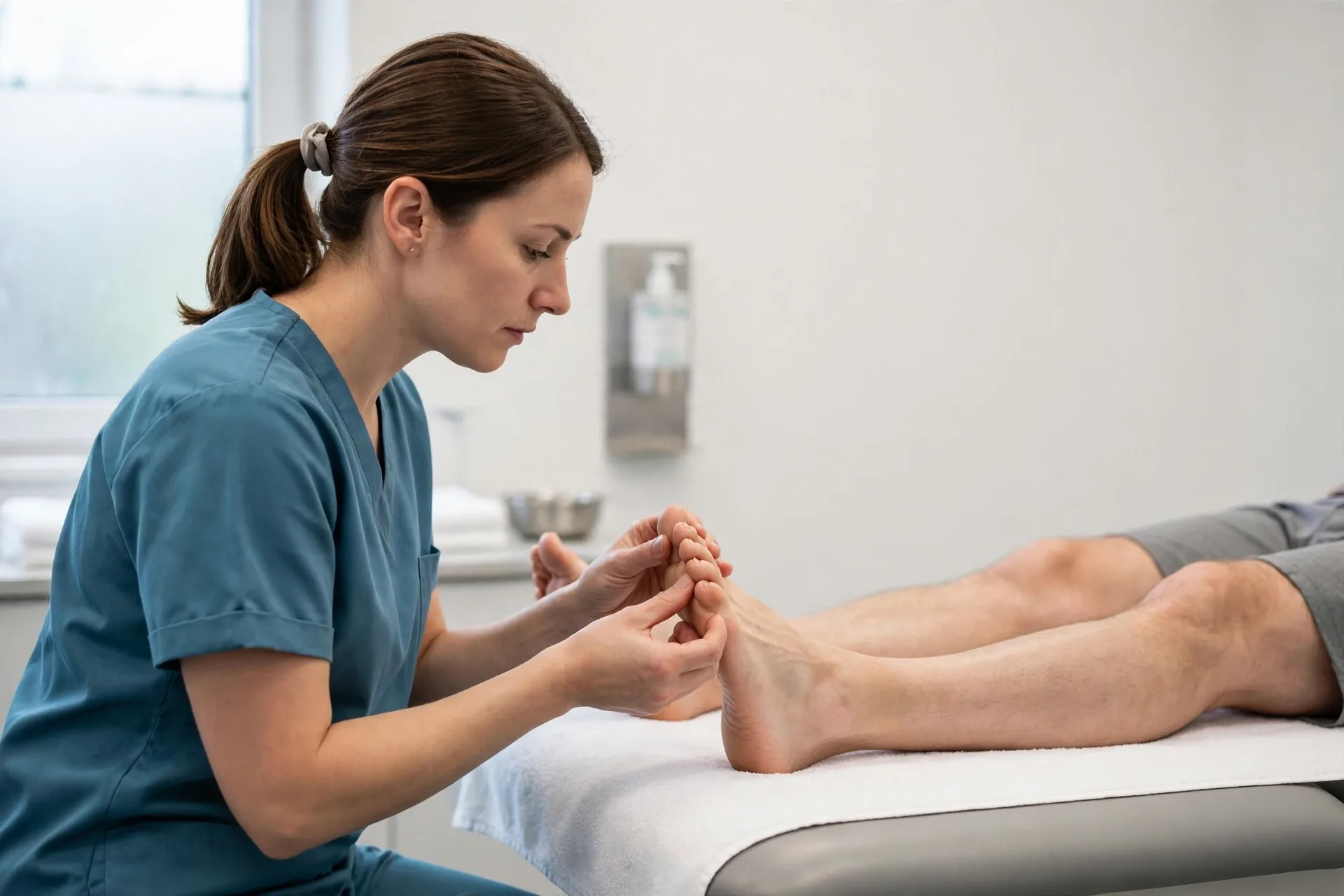
Foot and big toe assessment as part of bunion treatment at Renew Physiotherapy, Surrey
What Is a Bunion (Hallux Valgus)?
Your big toe joint, the first metatarsophalangeal (MTP) joint, is built for push-off. Every step rolls over it: as your heel lifts, the big toe bends back, the arch tightens like a winch, and the foot becomes a stiff lever that propels you forward. Two small bones called sesamoids sit under the joint and act like pulleys for the tendons that power push-off. In a well-aligned foot, the first metatarsal and the big toe sit in a fairly straight line, load is shared evenly across the ball of the foot, and the muscles that pull the toe inward and outward balance each other.
In hallux valgus, that balance is lost. The first metatarsal angles outward, the big toe angles inward, and the joint surfaces no longer sit squarely on each other. The tendons that should pull the toe straight start pulling it further sideways, like a bowstring slipping off centre. The inner side of the joint, now prominent, rubs against shoes, the soft cushioning sac over the joint (the bursa) can become inflamed, and the skin thickens. As the deformity progresses, the big toe may press against, overlap, or slide under the second toe, and weight shifts onto the smaller toes, which can develop hammertoes, corns, and pain under the ball of the foot, a pattern called transfer metatarsalgia.
Symptoms of a Bunion
Bunion symptoms range from none at all to pain that changes how you walk. The common pattern includes:
- A visible bony bump on the inner side of the foot at the base of the big toe, with the big toe leaning toward the second toe.
- Pain, tenderness, redness, or swelling over the bump, usually worse in tight or pointed shoes and after long periods on your feet.
- Trouble finding shoes that fit, especially closed dress shoes, safety boots, and narrow runners.
- Stiffness in the big toe joint, or a feeling that the toe does not bend properly at push-off.
- Corns or hard skin between the big toe and second toe, or callus under the ball of the foot from shifted load.
- Aching under the forefoot, burning or tingling over the bump if a small skin nerve is irritated by pressure.
- In more advanced cases, the second toe lifting, bending (hammertoe), or overlapping, and a sense of unsteadiness because the big toe no longer anchors push-off well.
Causes and Risk Factors for Bunions
Bunions rarely have one cause. They develop where an inherited foot shape meets years of load, and footwear can speed the process along. The main contributors are:
- Family history and inherited foot shape. This is the strongest factor. What runs in families is not the bunion itself but the foot type that leads to one: a slightly long first metatarsal, a loose or hypermobile first ray (the big-toe side of the foot), flat feet, or ligaments that stretch easily. If your mother or grandmother had bunions and your big toe is starting to drift, early assessment is worthwhile.
- Footwear. Contrary to popular belief, tight shoes are not the main cause of bunions, and some people who nearly always wear wide, comfortable shoes develop them anyway. But narrow, pointed toe boxes and high heels crowd the toes, push the big toe inward, and raise forefoot load, which can contribute to development and reliably makes an existing bunion sorer. Shoes are best understood as an accelerator and an irritant, not the whole story.
- Foot biomechanics. Flat feet, an unstable first ray, and tight calf muscles all change how load crosses the forefoot. A tight calf limits ankle bend, so the foot rolls inward earlier and longer in each step, stressing the inner forefoot. This is one reason calf flexibility and foot strength feature in almost every bunion program.
- Joint disease. Rheumatoid arthritis and other inflammatory conditions can damage the joint lining and ligaments, allowing the toe to drift. Osteoarthritis in the big toe joint (sometimes called hallux rigidus when stiffness dominates) can coexist with a bunion and change the treatment plan. Our guide to arthritis treatment in Surrey explains how arthritic joints are managed.
- Age and sex. Bunions become more common with age as ligaments loosen and feet widen, and they affect women more often, likely a mix of ligament laxity, foot structure, and footwear.
- Previous injury or surgery, and neuromuscular conditions that alter muscle balance around the foot can also predispose the joint to drift.
How a Bunion Is Diagnosed
Diagnosis is usually straightforward and starts with examination. Your physiotherapist or doctor will look at the foot standing, sitting, and walking: the position of the big toe and the bump, how the toes relate to each other, skin condition, callus pattern, how far the big toe joint bends, calf flexibility, foot posture, and how you push off. Bring the shoes you wear most, including work shoes and runners, because the wear pattern and toe-box shape tell part of the story. You will also be asked about pain behaviour, family history, previous foot problems, medical conditions such as diabetes or arthritis, and what your feet need to do each day.
Imaging is used when it changes decisions. The standard is a weight-bearing X-ray, taken standing, because the deformity only shows its true size under load. Clinicians measure angles, most commonly the hallux valgus angle (between the first metatarsal and the big toe; under about 15 degrees is typical) and the intermetatarsal angle (between the first and second metatarsals; under about 9 degrees is typical). Roughly, angles under 20 degrees are described as mild, 20 to 40 degrees as moderate, and over 40 degrees as severe, though symptoms matter more than any single number. X-rays also show joint arthritis, which influences surgical options if that path is ever chosen. Ultrasound or MRI is rarely needed. A physiotherapist cannot order imaging in place of a doctor, but we will examine the foot, explain findings in plain words, and coordinate with your doctor or a foot and ankle specialist when imaging or a surgical opinion is needed.
Bunion Treatment in Surrey: Conservative Care First
Conservative care relieves symptoms and protects function. It does not reverse bone alignment, and any product promising to straighten a bunion without surgery should be treated with scepticism. Night splints and toe separators may feel comfortable, but evidence they correct the deformity is weak. Conservative care reduces pressure, calms irritation, and keeps the foot strong and mobile. The main tools are:
- Footwear changes. This is the single most effective daily lever. Choose shoes with a wide, rounded toe box that lets the toes lie flat without squeezing, a soft upper that does not rub the bump, a low heel, and enough depth for any insert. Fit shoes late in the day when feet are at their largest, and check that you can wiggle your toes. Rocker-bottom soles can reduce bending demand at the big toe joint for people whose push-off is painful.
- Padding and protection. Gel bunion pads, moleskin, or a small foam spacer between the big and second toe reduce friction and pressure. Protective padding is especially useful in work boots and dress shoes you cannot easily replace.
- Orthotics and insoles. A cushioned insole or a custom orthotic can redistribute pressure away from the bump and the ball of the foot and support the arch. Orthotics manage load; they do not straighten bone. Your physiotherapist can advise whether an off-the-shelf insole is enough or a custom device is worth discussing with an orthotist or podiatrist.
- Activity modification. Temporarily reduce the activities that flare the joint: long walks in narrow shoes, high-impact forefoot loading, and prolonged standing on hard floors without breaks. Swap in lower-impact fitness such as cycling, swimming, or pool exercise while the joint is irritable, then rebuild walking volume gradually. If you run, forefoot load management matters, and our guide to ankle pain after running covers the same load-progression principles for runners.
- Taping. Physiotherapist-applied taping can temporarily support the big toe toward a straighter position and reduce strain during activity. Taping is a short-term symptom tool, useful for a long shift, a walk, or a return-to-sport session, not a correction.
- Pain relief measures. Ice after a long day on your feet can calm a hot, irritated bump, and warm soaks help some people at day's end. Over-the-counter anti-inflammatory medication is sometimes used short-term; discuss choices with your doctor or pharmacist, especially if you have stomach, kidney, heart, or blood-pressure concerns.
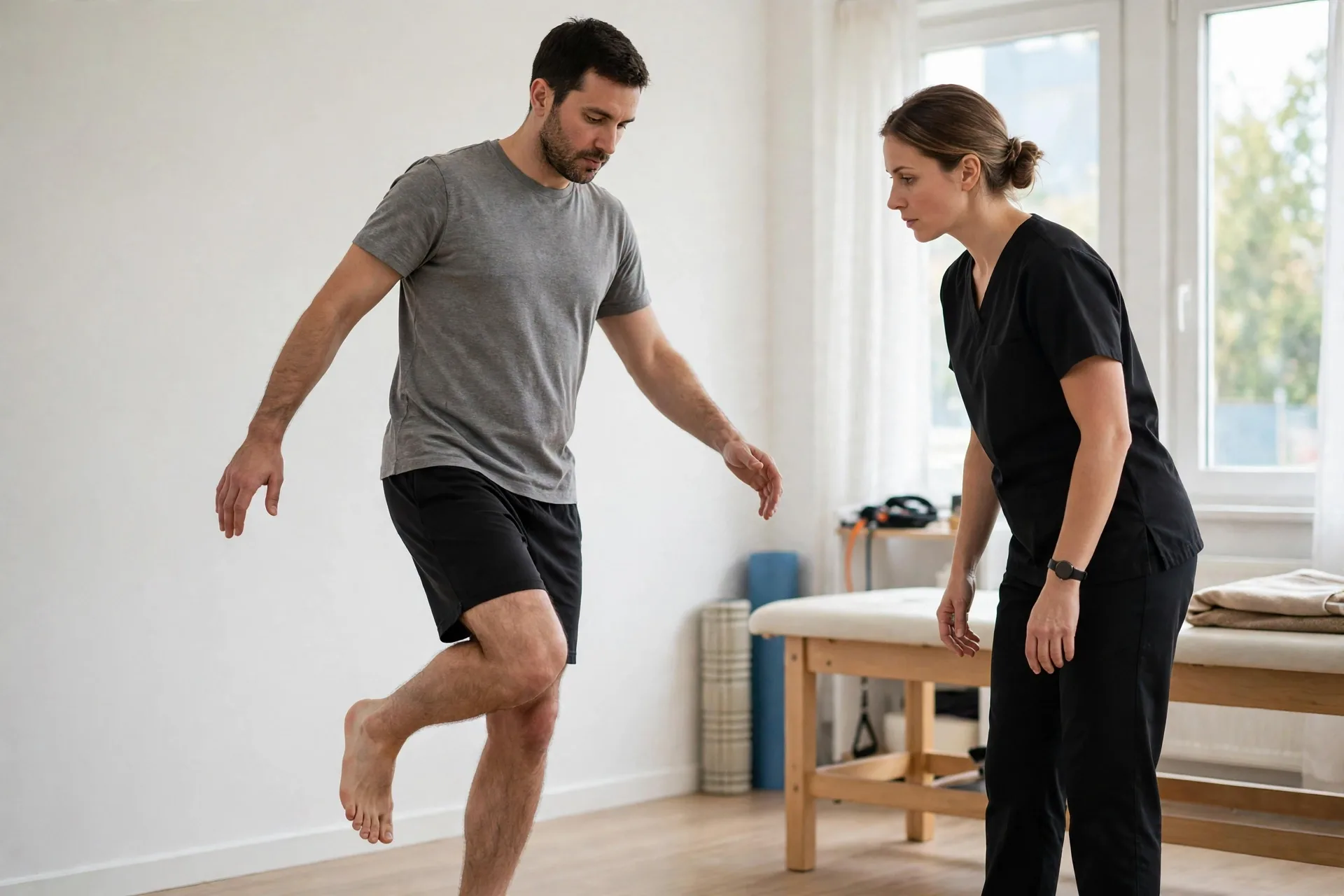
Single-leg balance and gait assessment during bunion rehabilitation at Renew Physiotherapy, Surrey
How Physiotherapy Helps a Bunion
Physiotherapy for a bunion has four honest goals: reduce pain, preserve big-toe mobility, strengthen the foot and calf so load is shared better, and keep you walking and working well. It does not push the metatarsal back into line, and a good program will tell you that clearly at the first visit. What it can do is change how the foot handles load, which is where most day-to-day symptoms come from.
At Renew Physiotherapy in Surrey, care starts with the assessment described above, then builds a program around your findings. Typical elements include hands-on joint mobilisation to maintain big-toe and midfoot movement, soft-tissue work for tight calf and foot muscles, calf stretching where ankle bend is limited, progressive strengthening of the small intrinsic muscles of the foot and the calf, balance and gait retraining so push-off uses the big toe again instead of rolling off the side of the foot, footwear and padding advice, taping for high-demand days, and a graded walking or return-to-activity plan. If you later choose surgery, the same clinic can guide rehabilitation as the bone heals. Progression is criteria-based: exercises advance when pain, mobility, and strength say the foot is ready.
Exercises for Bunions: Big-Toe Mobility, Foot Strength and Balance
These exercises are general guidance, not a prescription. They should feel like work or a gentle stretch, not sharp joint pain. If an exercise causes deep joint pain, swelling that lasts into the next day, or numbness, stop and tell your physiotherapist. People with diabetes, poor circulation, or reduced feeling in the feet should get individual advice before starting foot exercises or padding.
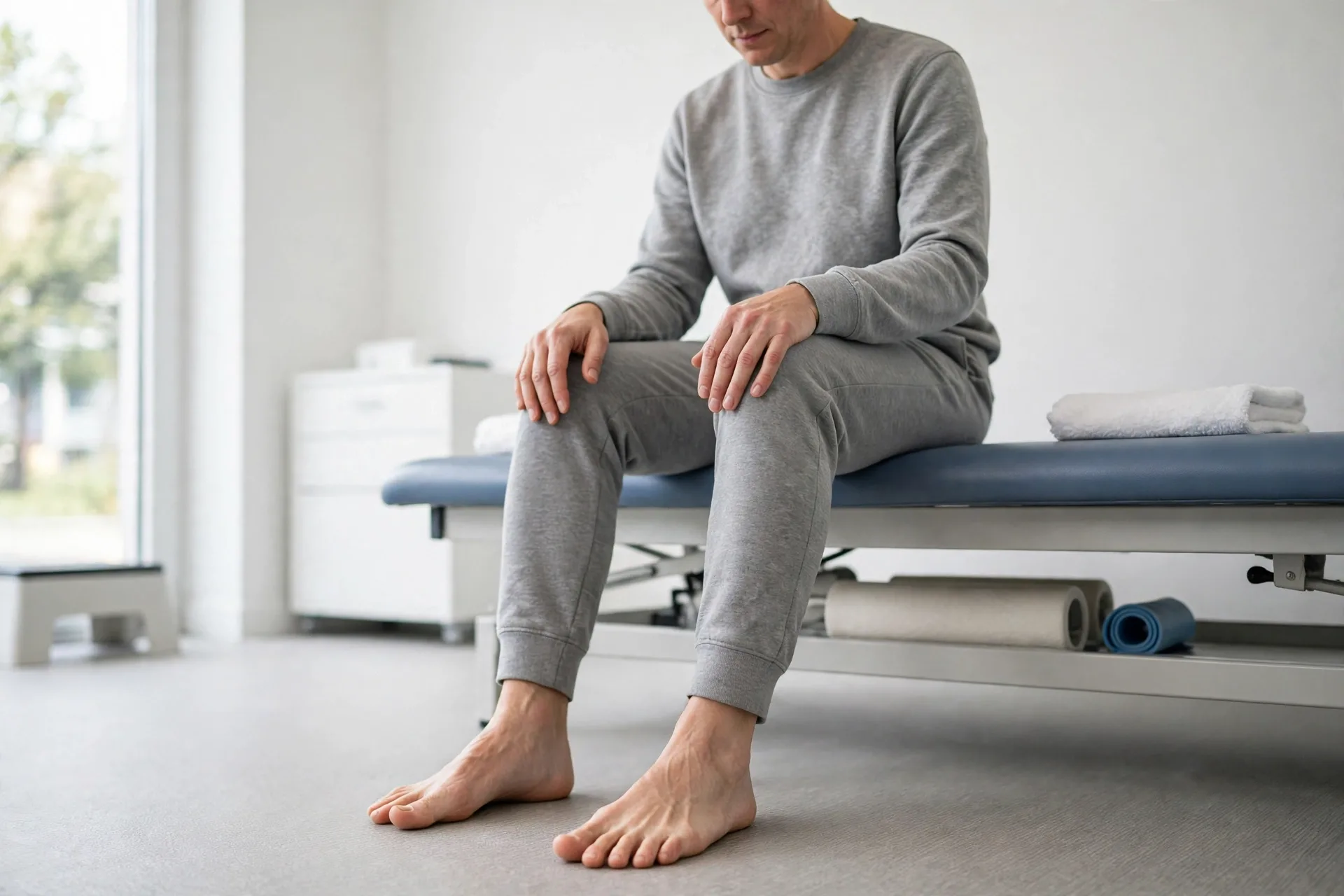
Seated foot and toe exercise practice in bunion rehabilitation at Renew Physiotherapy, Surrey
When Is Bunion Surgery Considered?
Surgery is the only treatment that corrects the bone alignment, and it is considered when pain and functional limits persist despite a fair trial of conservative care: when you cannot find shoes that fit, walking distance keeps shrinking, the toe deformity is progressing and crowding the second toe, or recurrent inflammation limits work and activity. Surgery is not recommended for appearance alone, and it does not guarantee a pain-free foot, so the decision belongs in a discussion with a foot and ankle surgeon who can examine you and review your X-rays.
Procedures are chosen by deformity severity, joint health, and stability. They range from soft-tissue balancing with a small bone cut near the joint (such as a chevron osteotomy) for mild to moderate deformities, through mid-shaft cuts (such as a scarf osteotomy) for larger corrections, to fusion at the base of the first metatarsal (Lapidus procedure) when the first ray is unstable, or fusion of the big toe joint when arthritis is advanced. Recovery varies: some procedures allow weight-bearing in a surgical shoe right away, others need weeks of protected weight-bearing, and swelling commonly lingers for months. Risks include recurrence, stiffness, numbness, delayed healing, and transfer pain. Physiotherapy after surgery restores toe motion, strength, and gait. An assessment can help you judge how much pain is pressure-related versus joint-related.
Red Flags: When to Get Checked Promptly
Most bunions are not emergencies, but some presentations should never wait for a routine appointment:
- A hot, red, very swollen big toe joint, especially with fever. This can be gout or infection and needs same-day medical assessment.
- Rapidly worsening pain, new inability to bear weight, or pain after an injury to the forefoot, which can mean a fracture.
- Skin breakdown, an ulcer, or a sore over the bump that does not heal, particularly if you have diabetes or poor circulation. Foot wounds in diabetes need prompt care.
- New numbness, burning, or colour change in the toes, or a foot that becomes pale, cold, or very painful.
- A bunion that is progressing quickly, with the big toe crossing over or under the second toe, or new hammertoe deformity and pain under the ball of the foot that is shrinking your walking distance.
- Pain that persists despite footwear changes and a proper trial of conservative care, which warrants X-ray review and a surgical opinion.
- A history of inflammatory arthritis with new forefoot swelling on both feet, which needs doctor review of disease control, not just footwear advice.
Preventing Bunions and Slowing Progression
You cannot change family history or foot shape, but you can reduce the forces that drive drift. Wear shoes with room for toes to lie flat, keep everyday heels low, and retire shoes that squeeze the forefoot. Keep calf flexibility and foot strength in your routine, maintain a healthy body weight, address flat-foot or gait issues early, and protect the bump with padding during long shifts. Act on early drift rather than waiting until shoes no longer fit: a flexible deformity is easier to manage than a stiff, arthritic one.
Bunion Care at Renew Physiotherapy in Surrey
Frequently Asked Questions
No. Physiotherapy, exercises, splints, and orthotics do not reverse the bone alignment of a bunion; surgery is the only treatment that corrects the deformity itself. What physiotherapy can do is reduce pain, preserve big-toe mobility, strengthen the foot and calf, improve balance and push-off, and help you stay active in comfortable footwear. Bunion treatment Surrey physiotherapists provide is honest about this from the first visit, and refers for a surgical opinion when pain persists.
No. Many bunions never need surgery. Treatment is only needed when the bunion causes problems, and for a large number of people wider shoes, padding, activity changes, and physiotherapy settle symptoms enough for daily life. Surgery is considered when pain and functional limits persist despite conservative care, when shoes no longer fit, or when the deformity progresses and crowds the other toes.
Not mainly. The strongest factor is inherited foot shape and ligament laxity. Tight, pointed, high-heeled shoes can contribute to development in a prone foot and reliably make an existing bunion sorer, but some people develop bunions despite a lifetime of wide, flat shoes. Footwear is best viewed as an accelerator and irritant rather than the sole cause, which is why changing shoes helps symptoms even though it cannot undo the alignment.
Exercises that maintain big-toe mobility and strengthen the foot help most people: big-toe circles and extension stretches, toe spread-outs, toe curls and points, towel scrunches or marble pickups, band-assisted big-toe abduction, calf raises with calf stretching, and single-leg balance. They ease pain and improve function and may slow progression, but they do not straighten the bone. Your physiotherapist will dose them to your joint mobility and pain response.
See a physiotherapist if bunion pain limits walking, work, or exercise, if shoes are getting hard to fit, if the big toe feels stiff, or if you notice callus, hammertoe change, or pain spreading under the ball of the foot. See a doctor promptly if the joint is hot and very swollen, if you cannot bear weight, if skin breaks down over the bump (especially with diabetes), or if pain persists despite footwear changes and conservative care, because X-ray review and a surgical opinion may be needed. No doctor's referral is needed to see a physiotherapist in BC.
There is no fixed healing time because a bunion is a long-standing alignment issue, not an injury with a set repair clock. Many people notice less shoe-pressure pain within a few weeks of footwear changes and starting foot exercises, with strength, balance, and walking tolerance building over 6 to 12 weeks. If surgery is chosen, recovery depends on the procedure, from weeks in a surgical shoe to months before swelling settles, with physiotherapy guiding toe motion and gait retraining.